
What Happens at Your First Court Date for an OWI in Indiana? (2026 Guide)
Zach Baber • April 2, 2026
There are certain things you should know before stepping into the Courtroom for the first time. This is our updated 2026 initial hearing guide.
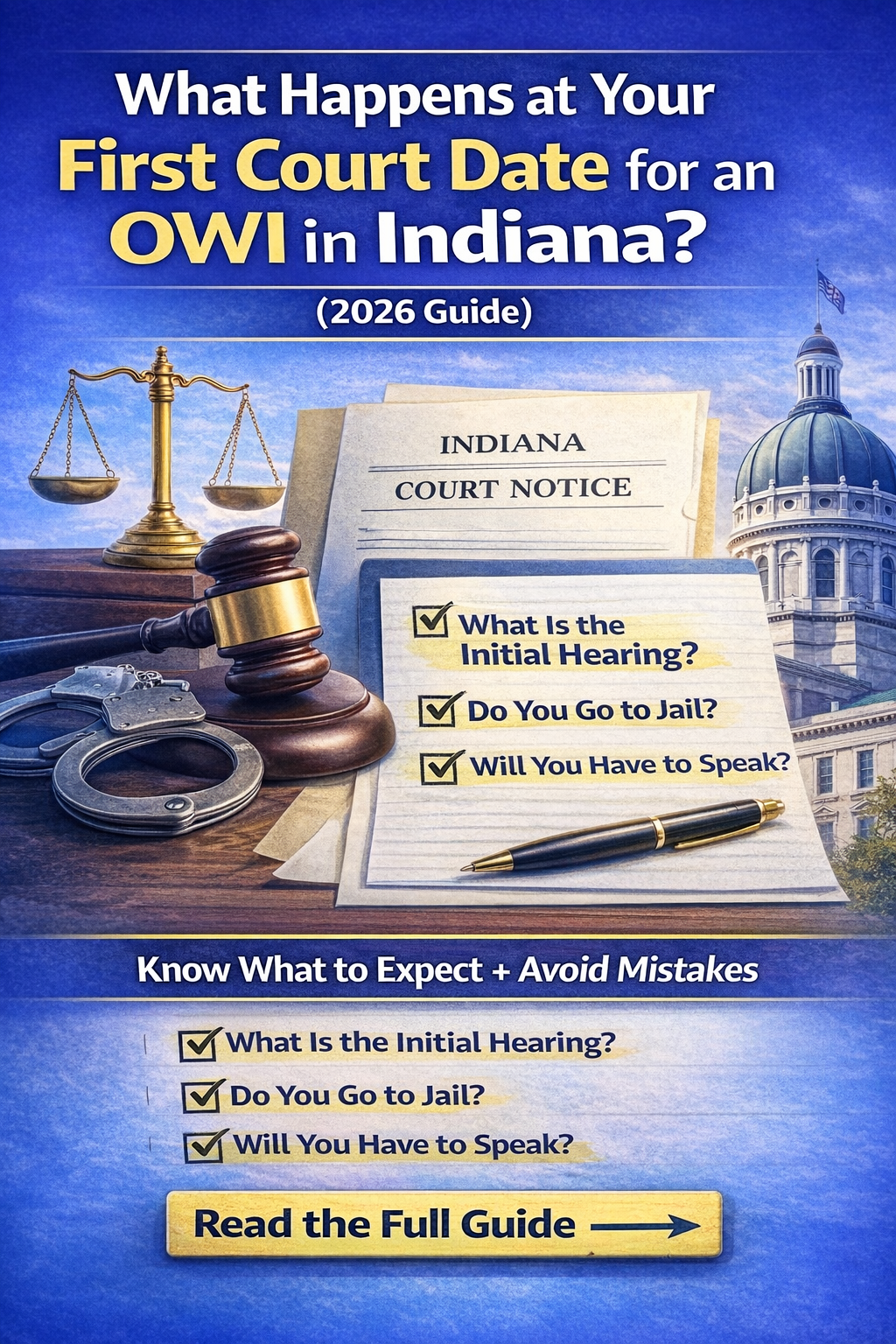
If you’ve been charged with an OWI or DUI in Indiana, your first court date can feel like a big unknown.
Most people are wondering:
“What is going to happen?”
“Am I going to jail?”
“Do I have to say anything?”
The good news is this:
What Is the First Court Date Called?
In Indiana, your first court appearance is typically called an initial hearing.
This is not a trial.
It is a procedural court date where the judge formally starts the case.
What Actually Happens at the Initial Hearing?
While every courtroom is slightly different, most initial hearings follow a similar structure.
1. The Judge Advises You of the Charge
The judge will:
2. You Are Informed of Your Rights
The judge will explain your rights, including:
3. The Court Addresses Representation
The court will ask whether:
4. Bond and Conditions May Be Reviewed
If you were released after your arrest, the court may:
5. A Future Court Date Is Set
At the end of the hearing, the judge will schedule the next step in your case.
This is often a pretrial conference, where the case begins to be evaluated more closely.
Will You Go to Jail at Your First Court Date?
This is one of the biggest fears people have.
In most OWI cases, you do not go to jail at your initial hearing.
Especially if:
Generally, you will speak very little.
At an initial hearing:
What Should You Do Before Your First Court Date?
Preparation matters more than people realize.
Here are a few key things:
✔ Show Up Early and Be Prepared
Being late or unprepared can create unnecessary problems.
✔ Follow All Conditions
If you were given instructions after your arrest, follow them carefully.
✔ Avoid Discussing the Case Publicly
What you say, even casually, can come back later.
✔ Understand This Is Just the Beginning
The initial hearing is not where your case is decided.
It’s where your case begins.
What Happens After the First Court Date?
After the initial hearing, your case moves into the pretrial phase.
This is where:
Common Mistakes to Avoid
Some of the biggest mistakes happen early:
The Big Picture
Your first court date is important, but it is not the final outcome.
Think of it as the starting point.
The real work in an OWI case happens after this hearing, when decisions are made that can affect:
If you’re feeling uncertain about your first court date, that’s normal.
Most people have never been through the process before.
Understanding what to expect can help reduce stress and prevent avoidable mistakes.
Need Help Understanding What Comes Next?
If you’ve been charged with an OWI or DUI in Whitley County or Northeast Indiana and want clarity about your case, it’s important to understand your position early.
At Baber & Baber, P.C., we help clients navigate the process step by step, from the first court date forward.
If you want to understand your situation and what your next steps may look like, call us at 260.244.4422 (phones answered 24/7) or send us a message by clicking here.
Most people are wondering:
“What is going to happen?”
“Am I going to jail?”
“Do I have to say anything?”
The good news is this:
- Your first court date is usually not as dramatic as people expect, but it is important.
Here’s what you should know.
What Is the First Court Date Called?
In Indiana, your first court appearance is typically called an initial hearing.
This is not a trial.
It is a procedural court date where the judge formally starts the case.
What Actually Happens at the Initial Hearing?
While every courtroom is slightly different, most initial hearings follow a similar structure.
1. The Judge Advises You of the Charge
The judge will:
- Tell you what you are charged with
- Explain whether it is a misdemeanor or felony
- Make sure you understand the accusation
2. You Are Informed of Your Rights
The judge will explain your rights, including:
- The right to an attorney
- The right to remain silent
- The right to a trial
3. The Court Addresses Representation
The court will ask whether:
- You have hired an attorney
- You plan to hire one
- You are requesting a public defender
4. Bond and Conditions May Be Reviewed
If you were released after your arrest, the court may:
- Review your bond
- Set or modify conditions
- No alcohol use
- No new criminal offenses
- Compliance with court orders
5. A Future Court Date Is Set
At the end of the hearing, the judge will schedule the next step in your case.
This is often a pretrial conference, where the case begins to be evaluated more closely.
Will You Go to Jail at Your First Court Date?
This is one of the biggest fears people have.
In most OWI cases, you do not go to jail at your initial hearing.
Especially if:
- You were already released after arrest
- You appear in court as required
- You follow bond conditions
- And you plead Not Guilty (not sure how you should plead at the Initial Hearing? Contact us by clicking here.)
Generally, you will speak very little.
At an initial hearing:
- You are not testifying about your case
- You are not arguing your case
- You are not explaining what happened
As long as you plead Not Guilty.
This is not the time to try to “talk your way out of it.”
HOWEVER: The judge will most likely suspend your driver's license at the initial hearing, but there are legal ways to ask for it back or delay the suspension. Read more here.
What Should You Do Before Your First Court Date?
Preparation matters more than people realize.
Here are a few key things:
✔ Show Up Early and Be Prepared
Being late or unprepared can create unnecessary problems.
✔ Follow All Conditions
If you were given instructions after your arrest, follow them carefully.
✔ Avoid Discussing the Case Publicly
What you say, even casually, can come back later.
✔ Understand This Is Just the Beginning
The initial hearing is not where your case is decided.
It’s where your case begins.
What Happens After the First Court Date?
After the initial hearing, your case moves into the pretrial phase.
This is where:
- Evidence is reviewed
- Legal issues are evaluated
- Strategy is developed
- Possible resolutions are discussed
Common Mistakes to Avoid
Some of the biggest mistakes happen early:
- Missing your first court date
- Not taking the charge seriously
- Violating bond conditions
- Speaking about the case without understanding the consequences
- Assuming “it will just work itself out”
The Big Picture
Your first court date is important, but it is not the final outcome.
Think of it as the starting point.
The real work in an OWI case happens after this hearing, when decisions are made that can affect:
- Your record
- Your license
- Your future
If you’re feeling uncertain about your first court date, that’s normal.
Most people have never been through the process before.
Understanding what to expect can help reduce stress and prevent avoidable mistakes.
Need Help Understanding What Comes Next?
If you’ve been charged with an OWI or DUI in Whitley County or Northeast Indiana and want clarity about your case, it’s important to understand your position early.
At Baber & Baber, P.C., we help clients navigate the process step by step, from the first court date forward.
If you want to understand your situation and what your next steps may look like, call us at 260.244.4422 (phones answered 24/7) or send us a message by clicking here.
BAC .15 or higher in Indiana can lead to a more serious OWI charge. Learn what it may mean for penalties, your license, and your defense.
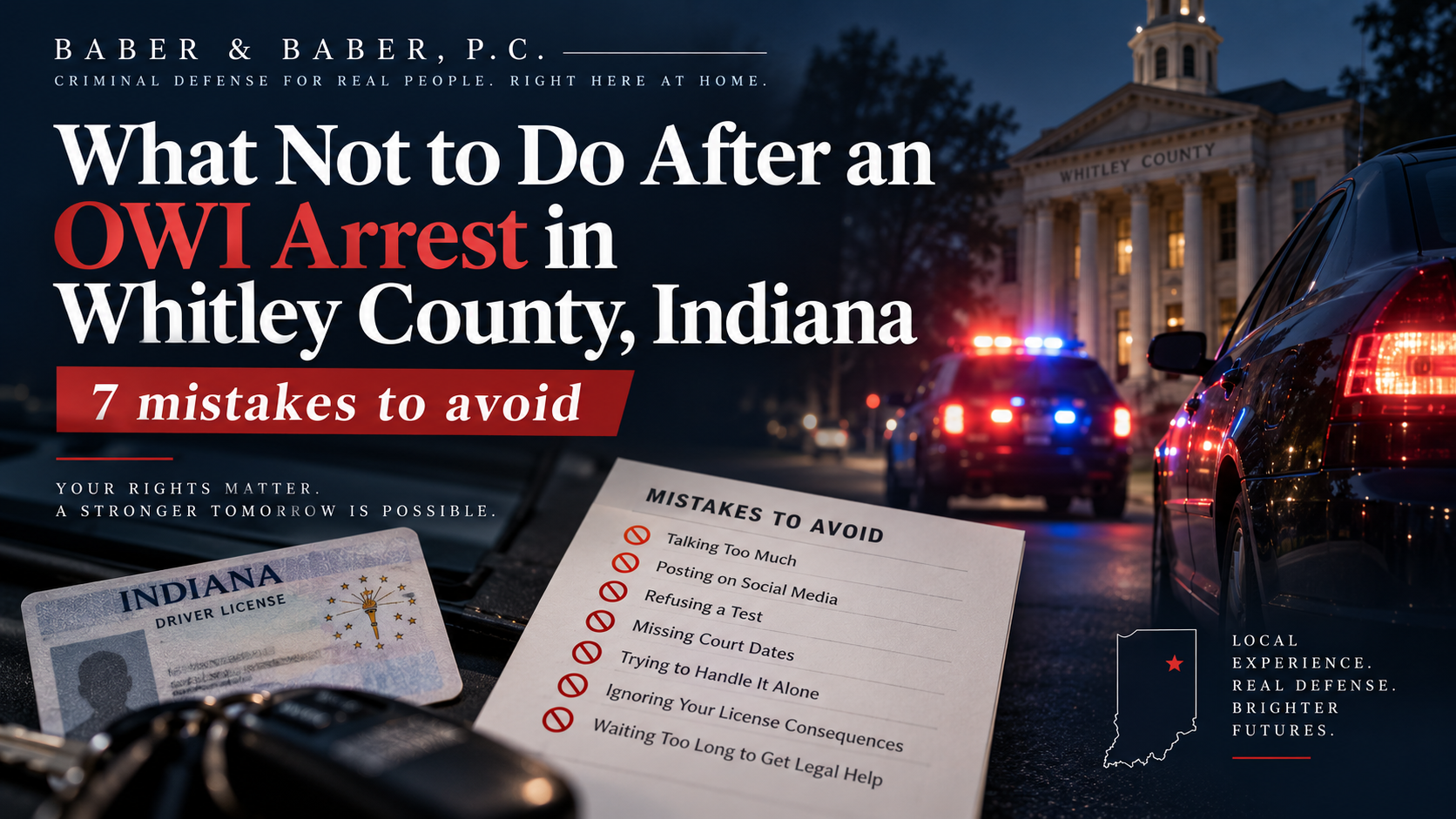
Arrested for OWI in Whitley County? Learn 7 mistakes to avoid involving driving, court, bond conditions, evidence, and social media.
Can you drive to work after an OWI arrest in Indiana? Learn how license status, specialized driving privileges, and interlock may apply.

Learn whether you may be able to keep driving after an OWI in Indiana, including ignition interlock, license issues, and legal driving options.

Charged with OWI in Whitley County? Learn what evidence may matter, including the stop, testing, body cam footage, and license issues.

Whitley County can be tough on OWI cases. Learn why local experience matters and what to consider after an OWI arrest.

Arrested for OWI in Whitley County? Learn what to do in the first 24 hours, including court dates, license issues, and next steps.

Learn how a DUI attorney can impact the outcome of a case in Warsaw, IN, with Baber & Baber, P.C. Attorneys at Law. Click here to keep reading.
Arrested for a DUI in Warsaw, IN? Baber & Baber explains booking, hearings, and license suspension. Call for a free consultation.
DUI vs. OWI vs. OVWI in Indiana? Baber & Baber explains the difference. Warsaw DUI Lawyer serving Kosciusko County. Call for a free consultation
