What Happens If You Violate Probation in Whitley County, Indiana? (2026 Guide)
Learn what happens after a probation violation in Whitley County, Indiana, including court hearings, bond issues, and possible jail time.
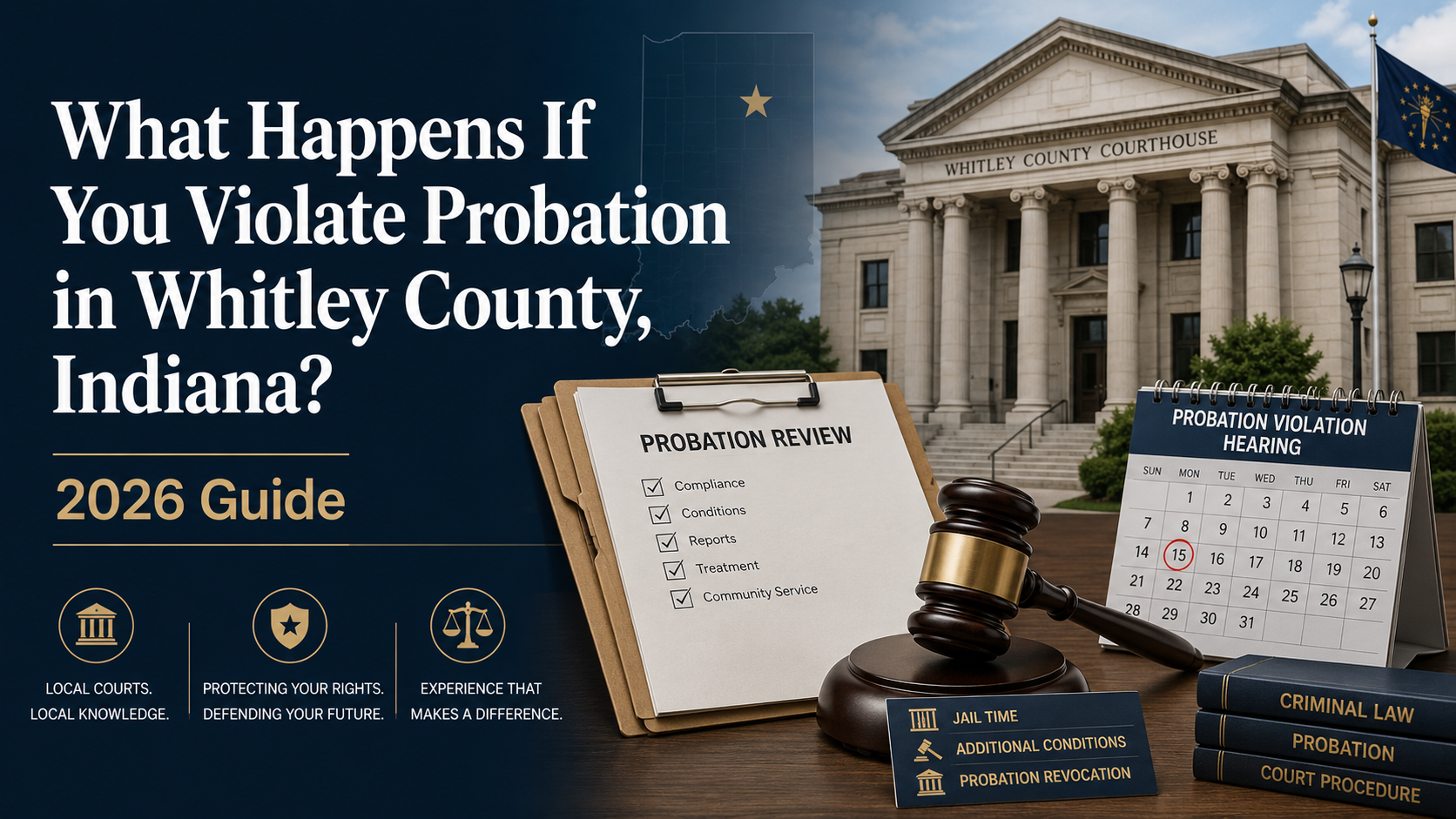
Being placed on probation can feel like a second chance.
But probation also comes with rules.
If probation believes you violated those rules, the court will take the situation seriously - and in Whitley County, probation violations can create serious consequences.
Many people facing a probation violation are asking:
“Am I going to jail?”
The honest answer is:
Maybe.
It depends on the type of violation, your history, the original sentence, and how the court views the situation.
This guide explains what generally happens after a probation violation in Whitley County, Indiana, and why it is important to take the situation seriously from the beginning.
What Is Probation?
Probation is a court-ordered sentence that allows a person to remain in the community instead of serving all or part of a sentence in jail or prison.
While on probation, you must follow specific conditions.
Those conditions may include:
- Reporting to probation
- Avoiding new criminal charges
- Passing drug or alcohol screens (common after OWI and drug offenses)
- Completing treatment or classes
- Paying fines, fees, and restitution
- Maintaining employment or school
- Avoiding contact with certain people
- Following travel restrictions
- Completing community service
- Obeying all laws
Probation is not the same thing as being free from consequences. It is still part of a criminal sentence.
What Counts as a Probation Violation?
A probation violation happens when probation believes you failed to follow one or more conditions of your probation.
Common alleged violations include:
- Missing probation appointments
- Failing a drug or alcohol screen
- Failing to complete treatment
- Not paying required fees or restitution
- Missing court
- Picking up a new criminal charge
- Violating a no-contact order
- Leaving the county or state without permission
- Failing to report a change of address
- Failing to complete community service
Some violations are more serious than others, but even a “technical” violation can create serious problems if ignored.
Technical Violations vs. New Criminal Charges
Probation violations generally fall into two broad categories.
Technical Violations
A technical violation means you allegedly broke a probation rule but were not necessarily charged with a new crime.
Examples may include:
- Missing an appointment
- Failing to report
- Not completing classes
- Testing positive for alcohol or drugs
- Falling behind on payments
- Missing community service
Technical violations can still result in jail time depending on the circumstances.
New Criminal Charges
A new criminal charge while on probation is often treated more seriously.
If you are charged with a new offense while on probation, the court may view that as a violation of the condition requiring you to obey all laws.
This can create two separate problems:
- The new criminal case
- The probation violation in the old case
That means one new arrest can affect both your current case and the sentence from your prior case.
What Is a Petition to Revoke Probation?
If probation believes you violated, a petition may be filed with the court.
This is often called a:
- Petition to revoke probation
- Petition to modify probation
- Notice of probation violation
The petition usually lists the alleged violations and asks the court to take action.
Once that petition is filed, the court may schedule a hearing, issue a summons, or issue a warrant depending on the situation.
Can a Warrant Be Issued for a Probation Violation?
Yes.
In Whitley County, probation violations can lead to warrants, especially if the allegation is serious, if the person failed to report, or if the court believes the person may not appear voluntarily.
Depending on the circumstances, the warrant may have a bond amount, or it may be issued with no bond.
A no-bond warrant means you may not be able to simply post money and walk out.
You may have to be held until the court addresses the violation.
Will You Go to Jail for a Probation Violation?
That is the question most people care about.
A probation violation can lead to jail, but jail is not the only possible outcome.
The court may consider:
- The type of violation
- Whether this is your first violation
- Your performance on probation before the violation
- Whether there is a new criminal charge
- Whether you were honest with probation
- Whether you completed treatment or other requirements
- The amount of suspended time available
- Your criminal history
- Public safety concerns
In some cases, the court may continue probation.
In other cases, the court may order jail time or require the person to serve part or all of the previously suspended sentence.
What Can the Court Do After a Probation Violation?
Under Indiana law, if the court finds that a probation violation occurred, the court may impose several possible sanctions.
Those may include:
- Continuing probation
- Modifying probation conditions
- Adding new requirements
- Extending probation
- Ordering part of the suspended sentence to be served
- Ordering all of the suspended sentence to be served
This is why probation violations are serious.
If you were given suspended jail or prison time at sentencing, that time may become an issue if the court finds a violation.
What Does “Suspended Sentence” Mean?
A suspended sentence is time the court did not require you to serve immediately, usually because you were placed on probation.
For example, someone might receive a sentence where part is served and part is suspended to probation.
If probation is violated, the court may have the ability to order some or all of that suspended time to be served.
This is one of the biggest risks in a probation violation case.
What Happens at the First Probation Violation Hearing?
The first hearing may involve several issues, including:
- Advising you of the alleged violation
- Addressing whether you admit or deny the violation
- Discussing bond or custody status
- Scheduling future hearings
- Determining whether the case can be resolved
A probation violation hearing is not the same as a new criminal trial, but it is still serious.
You should not assume it is “just a probation meeting.”
Once the court is involved, the consequences can be significant.
Should You Admit the Violation?
Not always automatically.
Some people want to admit immediately because they think honesty will fix the problem.
Honesty matters, but admitting a violation can have consequences.
Before admitting anything, it is important to understand:
- What probation is alleging
- Whether the allegation is accurate
- What evidence exists
- What sentence is at risk
- What the court may do after an admission
Every situation is different.
What If the Violation Is Based on a New Arrest?
If your probation violation is based on a new arrest, the situation can become more complicated.
You may have:
- A probation violation case
- A new criminal case
- A bond issue
- Possible custody concerns
- Separate court dates
Statements made in one case may affect the other.
That is why it is important to be careful before explaining yourself in court, to probation, or to law enforcement.
What If You Failed a Drug or Alcohol Test?
A failed drug or alcohol screen is a common probation violation allegation.
The outcome may depend on:
- What substance was involved
- Whether this is a first failed screen
- Whether treatment was already ordered
- Whether you were honest with probation
- Whether you are making progress in treatment
- Whether there are other violations
Sometimes the focus may be treatment.
Other times, the court may view the violation more harshly, especially if there have been repeated issues.
What If You Missed a Probation Appointment?
Missing a probation appointment can create problems quickly.
Probation officers and courts may view missed appointments as a sign that someone is not taking probation seriously.
If you missed an appointment, do not ignore it.
Waiting usually makes the problem worse.
What If You Cannot Pay Probation Fees or Court Costs?
Falling behind on fees or costs may be alleged as a violation in some situations.
However, inability to pay is different from simply refusing to pay.
If payment is the issue, documentation matters.
The court may consider:
- Employment status
- Income
- Efforts to make payments
- Other financial obligations
- Whether you communicated with probation
Do not ignore payment issues. Address them before they become bigger problems.
Why Whitley County Probation Violations Should Be Taken Seriously
Local practice matters.
In Whitley County, probation violations are not something to treat casually.
If probation files a violation, the court may act quickly, and the consequences can be serious.
That does not mean every violation results in jail.
But it does mean you should not assume the court will overlook it, especially if the violation involves a new charge, missed reporting, repeated noncompliance, or failure to appear.
What Families Should Know
Families often want to help when someone is facing a probation violation.
Helpful steps may include:
- Helping gather documents
- Confirming court dates
- Encouraging treatment or compliance
- Avoiding social media discussion
- Helping the person stay organized
Families should avoid contacting alleged victims, arguing with probation, or encouraging the person to ignore the violation.
The Big Picture
A probation violation does not always mean jail is guaranteed.
But it does mean the court may have the power to impose serious consequences, including ordering previously suspended time to be served.
The most important thing is to act quickly, understand what is being alleged, and take the process seriously.
Need Help With a Probation Violation in Whitley County?
At Baber & Baber, P.C., we help individuals in Whitley County and Northeast Indiana understand probation violations, warrants, bond issues, and the risks of suspended sentences.
If you have been accused of violating probation, or if you believe a violation may be filed, call us at 260.244.4422 or send us a message by clicking here.